
A Cost-per-Wear Guide to Compression Socks for Travel and Long Workdays
The budget question is not what costs least—it is what earns a place in your routine.
A low price is not automatically a bargain. If a pair of socks pinches, slides down, takes forever to dry, or only works with one shoe, it may spend most of its life in a drawer. Meanwhile, a better-designed pair that becomes part of every travel day or long shift can cost less each time you wear it.
Compression socks are a good category for cost-per-wear thinking because comfort, fit, material, and care all affect whether you will actually reach for them. The goal is not to buy the fanciest pair. It is to identify the features that make a pair useful in your real week.
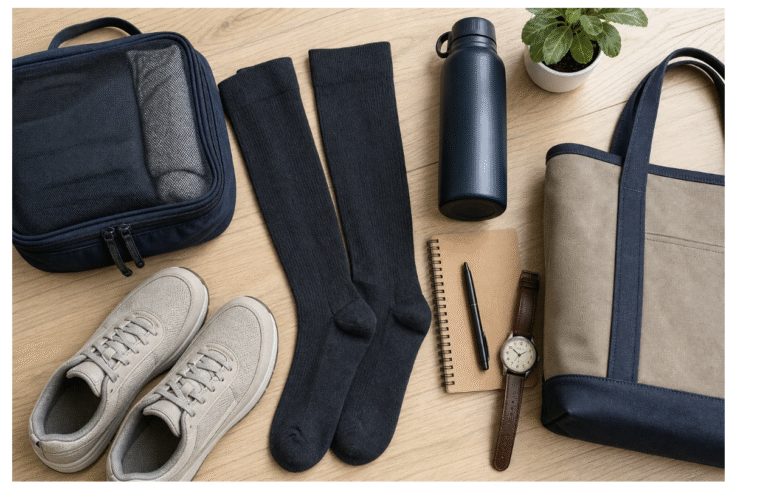
A useful pair should work across the real places your week takes you.
Start With the Job You Need the Sock to Do
Write down the main situation before you compare products. Is the pair for long flights, standing at work, daily commuting, or extended walking? A clear use case keeps you from paying for features that sound impressive but do not solve your problem.
Next, list the shoes and clothes you will wear with them. A smooth black knee-high can disappear beneath work trousers and also pair with travel sneakers. A thick hiking style may be excellent outdoors but too bulky for loafers. Versatility begins with an honest look at your closet.
Use a Simple Cost-per-Wear Formula
The calculation is straightforward:
Purchase price ÷ number of wears = cost per wear.
The difficult part is estimating the wears. Instead of guessing, use your calendar. If you travel twice a month and expect to wear a pair on both the outbound and return days, that is roughly 48 wears in a year. If you stand for long shifts three days a week, the potential use is much higher—but only if you own enough pairs to rotate and wash them conveniently.
Run the formula for one year, then compare it with a cheap pair you have already stopped wearing. The best value is often the item that stays comfortable and presentable long enough to complete the planned rotation.
Compare Construction, Not Just the Headline
Read the fiber list, height, ventilation, stretch, cushioning, and washing directions. Technical fibers can improve softness, shape retention, and drying time. Merino wool may add comfort and moisture management. Stretch fibers help create a closer fit. The value lies in how those elements work together.
For example, MP Magic’s merino wool compression socks combine knee-high coverage with TACTEL nylon, merino wool at the sole and toe, stretch, mesh ventilation, and machine-washable care. That mix is designed for business, travel, workouts, and daily wear, making the pair a useful comparison point for shoppers who want one style to cover several situations.
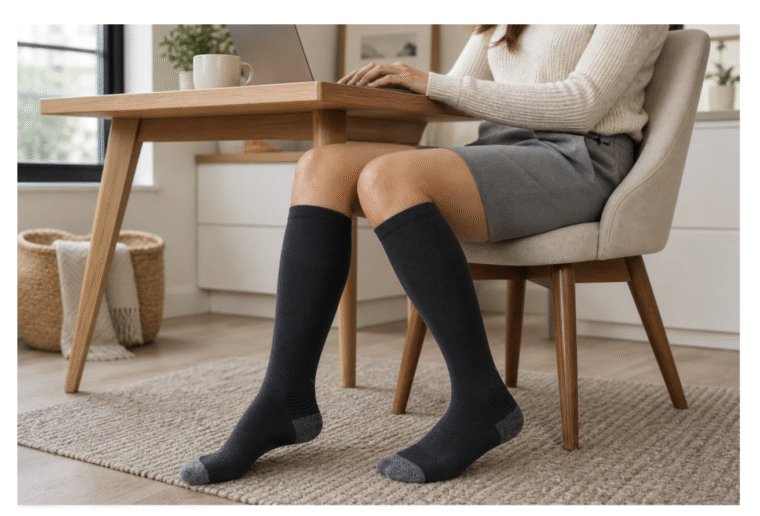
Do not assume that a higher wool percentage or a firmer feel is always better. The correct balance depends on shoe space, climate, sensitivity, and how long the socks will be worn.
Fit Is a Budget Issue
A pair that does not fit is expensive at any price. Use the brand’s current size chart and measure as directed. Do not deliberately size down to create more pressure; a compression garment should be selected according to the maker’s guidance.
Check the return policy before removing tags or washing. If you have been advised to use a specific compression level for a health condition, follow your clinician’s recommendation rather than treating a general lifestyle sock as a substitute.
Once the pair arrives, test it at home for a short period before committing to an all-day trip. Notice the cuff, toe seam, heel placement, and whether the fabric bunches inside the shoe.
Build the Pair Into Three Real Outfits
- Travel day: dark trousers, breathable top, cardigan or blazer, walking shoes, and a black knee-high pair.
- Long workday: straight-leg pants, loafers or supportive sneakers, and a sock that stays visually quiet beneath the hem.
- Active weekend: joggers or hiking trousers, a light jacket, and comfortable walking shoes.
If the same pair works in all three formulas, it has a strong chance of reaching a low cost per wear. Neutral colors generally offer more combinations, while a consistent knit thickness makes shoe fit predictable.
Make Care Easy Enough to Repeat
A washable pair only saves money if the care routine protects it. Follow the label’s maximum temperature, drying method, and restrictions. Avoid bleach when prohibited, and keep knit socks away from rough zippers and hook-and-loop straps in the wash.
Use a mesh laundry bag if single socks regularly disappear in your household. Rotate between pairs so each one can dry fully, and store them flat or loosely folded instead of stretching one cuff around both socks.
Try a 30-Wear Challenge
After buying, keep a simple tally in your notes app. At 10 wears, ask whether the pair is still comfortable. At 20, check shape, pilling, and the heel and toe. At 30, calculate the actual cost per wear and decide whether the construction has justified the purchase.
This small habit turns a vague impression into useful shopping data. It also reveals which colors, thicknesses, and heights belong in your wardrobe—and which ones do not deserve a repeat purchase.
The Savvy Bottom Line
Budget shopping is not about choosing the lowest number on the product page. It is about spending deliberately, using what you buy, and avoiding replacements caused by poor fit or impractical care.
Define the job, estimate realistic wears, compare construction, and track the result. When a pair supports multiple parts of your week and survives the routine, the value shows up one wear at a time.
