
Growing as a Therapist: How Clinical Supervision Protects and Inspires Your Career

The journey of a mental health practitioner is defined by ongoing growth, self-reflection, and refined clinical skill. While foundational education and licensing exams equip counselors with essential theoretical knowledge, the real-world practice of therapy presents nuanced challenges that textbooks alone cannot prepare one for. Clinical supervision serves as a cornerstone of long-term professional development, bridging academic theory with practical application while safeguarding client welfare and fostering practitioner resilience.
Engaging in structured supervision allows counselors at every career stage to navigate the complexities of clinical work with confidence. Rather than viewing supervision merely as a regulatory requirement for licensure, experienced professionals recognize it as a dynamic engine for clinical judgment, ethical grounding, and sustained career satisfaction.
Reflecting on Difficult Cases and Developing Clinical Judgment
Every clinician encounters cases that test their therapeutic approach, elicit complex emotional responses, or seem to stall despite evidence-based interventions. Clinical supervision provides a structured, confidential space to unpack these challenging dynamics.
Through regular case consultation, counselors can:
- Identify Countertransference: Uncover subtle personal biases or emotional reactions toward clients, converting potential therapeutic blind spots into valuable clinical insights.
- Refine Conceptual Models: Move beyond basic treatment protocols to synthesize multiple theoretical frameworks, tailoring approaches to individual client needs.
- Practice Deliberate Reflection: Analyze therapeutic interactions after the fact to evaluate what interventions were effective and where alternative strategies might yield better outcomes.
Over time, this continuous reflective practice transforms raw experience into mature clinical judgment. Counselors learn to trust their intuition while keeping it firmly anchored in conceptual rationale and client-centered goals.
Recognizing Limits of Competence and Ethical Decision-Making
Navigating complex ethical boundaries is an inevitable reality of mental health practice. Issues surrounding dual relationships, confidentiality exceptions, client self-harm risks, and cultural responsiveness frequently present nuanced grey areas. Clinical supervision functions as a critical safety net, helping practitioners evaluate complex scenarios before taking action.
A primary responsibility of clinical supervisors is assisting clinicians in recognizing the boundaries of their professional competence. When encountering unfamiliar client presentations, specialized diagnoses, or modalities outside their training scope, supervision helps clinicians determine whether to pursue targeted continuing education, consult specialized advisors, or execute an ethical referral. Maintaining this disciplined focus on competence protects client safety while reinforcing the practitioner’s ethical integrity.
Distinguishing Supervision from Personal Therapy and Informal Peer Support
To fully leverage clinical supervision, practitioners must understand how it differs from other support systems, such as personal therapy or informal peer consultation. While all three contribute significantly to a counselor’s overall well-being, each serves a distinct professional function.
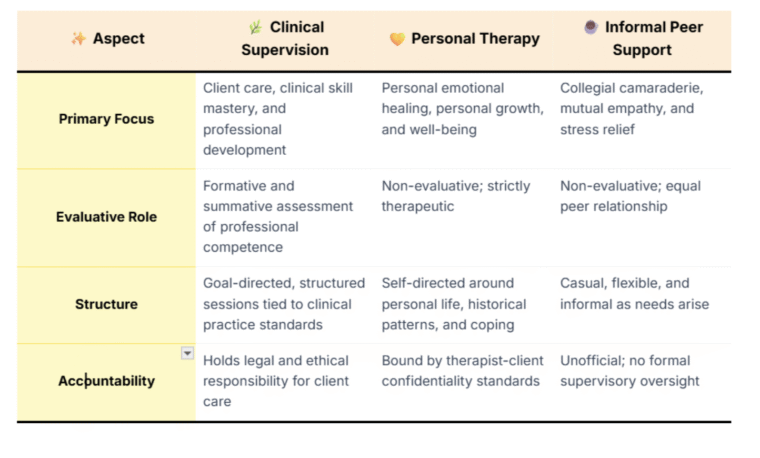
While personal therapy supports the individual behind the clinician and peer support alleviates the isolation of practice, supervision specifically cultivates professional efficacy and ensures systemic accountability in client care.
Long-Term Professional Growth and Educational Pathways
As practitioners gain years of experience, their career goals often expand beyond direct client care. Many clinicians discover a strong affinity for mentorship, clinical education, administrative leadership, or research. Supervision provides a natural vantage point from which to observe these evolving interests and plan deliberate career pathways.
For counselors interested in mentoring the next generation of therapists or stepping into administrative roles, advanced training becomes a valuable consideration. Clinicians exploring formal avenues in teaching, clinical supervision, or scholarly research often review higher education options to deepen their expertise.
For instance, pursuing a PhD in counseling offers one academic route designed for professionals interested in counselor education, advanced practice, or supervisory roles. While doctoral study or formal supervision credentials are not required for every counseling career, investigating structured educational pathways allows practitioners to align their choices thoughtfully with their personal trajectory and professional aspirations.
Practical Tips for Maximizing Supervision
To derive the maximum benefit from supervision sessions, counselors should approach each meeting with intentionality and preparation.
- Maintain a Dedicated Supervision Log: Note challenging client moments, ethical questions, or emotional reactions immediately after client sessions so they can be brought to supervision without relying on memory alone.
- Formulate Specific Case Questions: Instead of presenting a general case overview, frame consultations around explicit questions (e.g., “How can I manage resistance when discussing boundary settings with this client?”).
- Cultivate Receptivity to Feedback: Approach constructive critique as a constructive tool for growth rather than a reflection of personal capability.
- Set Annual Learning Goals: Work collaboratively with your supervisor at the start of each year to establish clear objectives for clinical skill development, specialized certifications, or theoretical integration.
Conclusion
Clinical supervision is far more than a stepping stone toward initial licensure; it is a lifelong catalyst for professional excellence. By offering a dedicated space to examine difficult cases, uphold ethical standards, and clarify long-term career aspirations, supervision enhances both clinician resilience and client outcomes. Engaging thoughtfully in clinical supervision ensures that practitioners remain effective, reflective, and inspired throughout their professional journeys.
