
The Bohemian Express: From the Thermal Baths of Budapest to Prague’s Spired Skyline
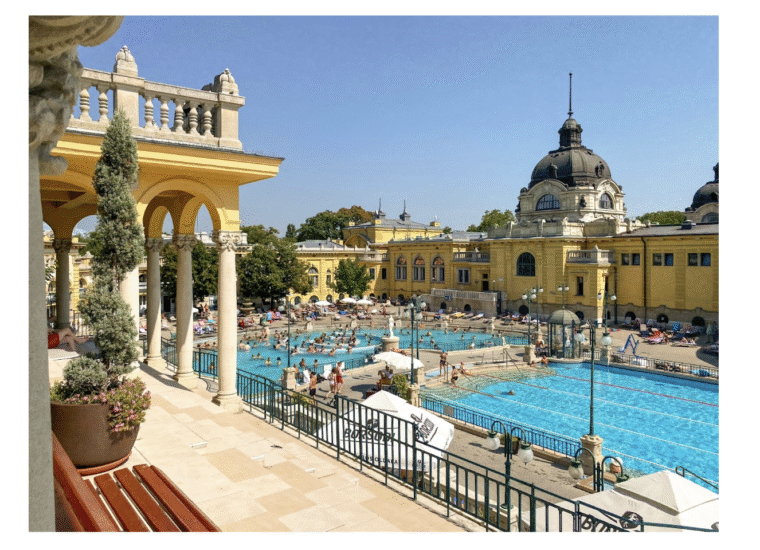
Budapest begins in water. Not the river alone, though the Danube moves steadily between Buda and Pest, but the warmth rising from beneath the city — steam drifting upward in early light, stone holding heat longer than expected. Morning gathers slowly around the baths. Tiles glow faintly beneath a pale sky. Conversations remain low, as if softened by humidity.
There is something suspended about these spaces. Domes curve overhead. Water laps against marble edges. Time feels less linear here, measured instead in ripples and drifting vapour. Even outside, the city seems to carry that same unhurried rhythm. Trams cross bridges without urgency. Facades lean toward the river as though aware of its presence.
Departure feels gradual rather than abrupt.
Where Steam Fades into Landscape
Leaving Budapest rarely feels like stepping away from something complete. The city lingers in fragments — tiled interiors, the metallic scent of thermal pools, the muted gold of late afternoon along the Danube. Movement north begins almost quietly, the countryside unfolding in measured sequences beyond the window.
Along routes that resemble trains from Budapest to Prague, the terrain shifts from riverbank density to open fields and low hills without clear boundary. Villages gather near stations and then dissolve into farmland. Industrial edges appear briefly before receding again. The sky widens.
Inside the carriage, reflections overlap with scenery. The glass carries faint traces of what lies behind as much as what lies ahead. The sense of transition feels more atmospheric than geographical.
Approaching Spires Without Announcement
The landscape grows subtly more wooded as Prague draws nearer. Church towers begin to appear at irregular intervals, not yet clustered, but present enough to suggest what is coming. Rooflines sharpen slightly. Fields narrow.
On longer loops through Central Europe, sometimes connected by a train from Munich to Prague, the repetition of movement becomes familiar — forests, towns, bridges — yet never identical. Direction shifts, but the rhythm holds.
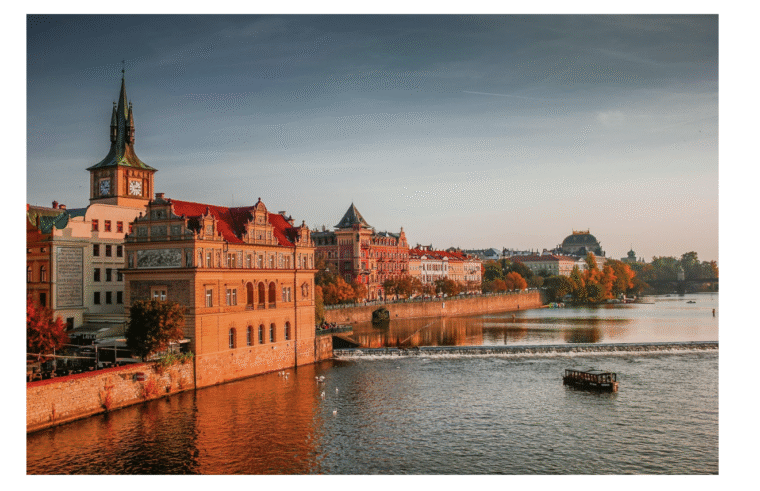
Arrival in Prague does not feel explosive. It accumulates. The spires rise gradually above the Vltava. Bridges stretch across the water in steady lines. Stone darkens slightly compared to Budapest’s warmer tones, yet the atmosphere remains restrained.
A Skyline Built in Layers
Prague’s Old Town gathers height rather than width. Spires punctuate the horizon in uneven intervals. Cobbled streets bend gently, rarely revealing their full length at once. The city seems to lean upward.
Shadows deepen between buildings. Windows catch fragments of sky. The river reflects darker tones, more contained than the Danube’s breadth. Movement slows naturally here, though nothing explicitly asks for it.
Thermal warmth feels distant now, replaced by the cooler clarity of northern light. Yet both cities share a kind of contained intensity — Budapest through water and depth, Prague through verticality and stone.
Between River and River, a Quiet Continuation
Later, memory resists clean separation. Steam rising from baths overlaps faintly with the outline of Prague’s towers. The Danube’s wide sweep merges with the Vltava’s narrower path. Even the train windows feel similar — reflections layered against shifting fields.
The journey becomes less about endpoints and more about pacing. Rails fixed across plains. Bridges crossing water without fanfare. Stations appearing briefly before falling away.
What remains is not spectacle, but sequence. Heat softening stone in Budapest. Cool light settling along Prague’s rooftops. Fields stretching quietly between them.
And somewhere along that line — between steam and spire — the movement continues without insisting on contrast, holding both cities within the same steady, almost unremarkable rhythm of passage.
