
Where the Money Comes From When a $600 Repair Bill Shows Up Before Payday

The Quick Version
- Surprise bills are normal, not a sign you are bad with money. The Federal Reserve found that 59 percent of adults had a major unexpected expense last year, and a car repair was the most common one.
- Before you borrow a cent, check the money you already have access to: sinking funds, bill timing, and the provider’s own payment plan.
- If borrowing is the answer, compare the total cost by APR rather than by monthly payment, and read the terms before you agree to anything.
- The cheapest emergency is the one you saved for, so the last step is always to start a small, automatic cushion this month.
A surprise bill is a timing problem before it is a money problem. The mechanic wants $600 on Thursday, your paycheck lands the following Friday, and the gap between those two dates is where most of the stress lives. Families who handle these moments well are not usually the ones with the most money. They are the ones with a plan for the order in which they will look for it, starting with what they already have and borrowing only if nothing else closes the gap.
How Often Do Surprise Bills Actually Happen?
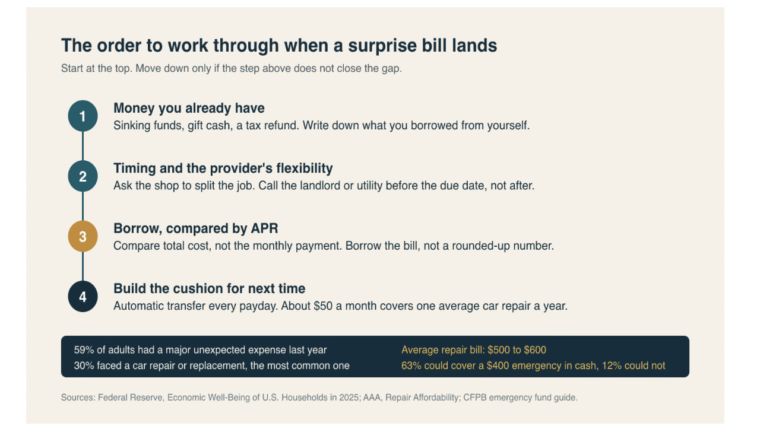
More often than the tidy budget spreadsheets suggest. The Federal Reserve’s 2025 Survey of Household Economics and Decisionmaking found that 59 percent of American adults had at least one major unexpected expense in the previous 12 months. The most common was a big vehicle repair or replacement, which hit 30 percent of adults. A house or appliance repair came next at 22 percent, and a major medical bill followed at 21 percent.
The car figure is no surprise to anyone who has owned one past its warranty. AAA puts the average repair bill between $500 and $600, and its research found that about one in three drivers could not pay for an unexpected repair without going into debt. The Fed’s numbers tell the same story from the other direction. Sixty-three percent of adults said they could cover a $400 emergency from cash, savings, or a credit card they pay off in full, while 12 percent said they could not pay it at all right now.
If you are in that second group this month, you have plenty of company, and you have more options than it feels like at 5 p.m. on a Thursday.
Where Should You Look Before You Borrow?
The first place is money that already exists but is earmarked for something else. If you keep sinking funds for the holidays or a vacation, a car repair is exactly the kind of emergency that justifies raiding one, as long as you write down what you took and top it back up. The trip can move by a month, while the car cannot.
The second is timing. Most bills have more flexibility than their due dates imply, and the Fed’s survey shows how often people use it. Among adults who struggled to pay bills in a given month, 42 percent paid a bill late and 16 percent negotiated a lower payment or more time to pay. Calling a utility or a landlord before the due date, rather than after, is what turns “late” into “arranged,” but ask what the arrangement costs before you agree, because some providers still charge a late fee or report the delay, and a missed rent date can carry consequences no repair bill is worth.
The third is the repair shop itself. Many independent mechanics will split a large job into stages, hold a repair until the next paycheck, or point you toward a payment plan they already offer. Ask before the work starts, because the answer is almost always better then than it is when you are standing at the counter with the keys already in their hand.
What Does Borrowing Actually Cost, and How Do You Compare?
Sometimes the honest answer is that none of the above closes the gap, and borrowing is the least bad option. The Fed found that among people who would not cover a $400 emergency in cash, the most common fallback was putting it on a credit card to pay off over time, chosen by 15 percent of all adults. Borrowing from a friend or family member came next at 10 percent. Both can work, and both have costs that are easy to underestimate, whether that is interest that keeps running or a relationship that gets awkward.
If you are looking at a loan, the single most useful habit is to compare the annual percentage rate rather than the monthly payment. The Consumer Financial Protection Bureau explains that the APR includes the interest rate plus fees charged when the loan is made, which is why it is the fair way to compare two offers that look different on paper. A low monthly payment stretched over a long term can cost far more in total than a higher payment over a shorter one. The disclosures a lender is required to give you will show the full amount you would repay.
That comparison has become easier to do from the kitchen table. Instead of applying to lenders one at a time, many families now compare flex loans online through a single form that goes out to a network of lenders, so they can see what each one is willing to offer before deciding. FlexMoney.com works this way and is clear that it is not a lender itself. The lenders in its network offer loans from $200 up to $35,000, though not every lender goes that high, with repayment plans of 12 to 30 months. The site states that its lenders’ APRs are 35.99 percent and below for qualified borrowers, that approval is up to each lender, and that funding can arrive as soon as the next business day. The service is not available in every state, so read the terms you are offered as carefully as you would read the mechanic’s estimate.
Whatever you choose, borrow the amount of the repair rather than a rounded-up number, and know the date you will have it paid off before you sign. A loan with a clear end date is a tool, while a loan that quietly becomes a monthly fixture is a second problem.
How Do You Keep This From Happening Next Time?
You start the cushion this month, even if it is small. The Consumer Financial Protection Bureau’s guide to building an emergency fund suggests looking at the most common surprise expenses you have actually had and using that as your target. It then recommends an automatic transfer from checking to savings, so the money moves before you can spend it. The guide also makes the point that even a small amount provides some security, which is worth hearing if a full three-month fund feels impossibly far away.
For car owners specifically, AAA’s suggestion is to save at least $50 a month for car trouble and to pick a trusted repair shop before you need one, because choosing a mechanic is much easier when the car is not sitting on the shoulder of the highway. Fifty dollars a month is $600 a year, which is one average repair bill covered entirely in cash.
Tax refunds and cash gifts are the other shortcut. Sending even half of a refund straight to the emergency account, before it has a chance to become a new couch, can build in one afternoon what would otherwise take most of a year.
The Order Matters More Than the Amount
Nobody plans for the transmission, but you can plan for the order you will work through when it happens. Your own earmarked money comes first, then timing and the provider’s own flexibility, then a careful comparison of borrowing costs. The final step is the automatic savings that make the next repair a nuisance instead of a crisis. None of that requires more money than you have today, only a decision about the order in which you will look for it, made before the mechanic calls rather than after.
