
Where Does USDT Interest Come From? Lending, Market Making and On-Chain Yield
Quick Answer
USDT does not produce interest simply by sitting in a wallet. Yield begins only when USDT is lent to borrowers, supplied as trading liquidity, deployed through an on-chain strategy, or placed in a platform-funded rewards program.
The return ultimately comes from borrower interest, trading fees, spreads, derivatives funding, protocol incentives, or promotional budgets, not the token itself. Higher APY generally signals more borrowing demand, longer lockups, subsidies, complexity, or risk.
Tether describes USDT as a reserve-backed token, not a yield-bearing instrument. Any interest a platform offers comes from a separate arrangement layered on top of your deposit.
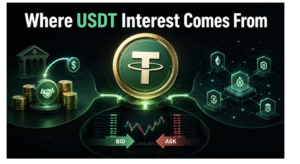
Key Takeaways
- USDT itself does not automatically pay interest, it must be deployed somewhere.
- Lending yield comes from borrowers paying to access USDT.
- Market-making yield comes from trading fees, spreads, funding payments, and incentives, not conventional loans.
- “On-chain yield” is a delivery method, not a distinct revenue source.
- Promotional rewards can temporarily inflate APY without changing the strategy’s real return.
- Every yield source shifts a different mix of credit, custody, liquidity, and market risk onto the depositor.
Platforms often show one APY number and little else. Two products advertising the same 5% can have completely different cash flows and loss scenarios, this article traces each yield type back to who pays it, rather than ranking platforms.
Does USDT Generate Interest by Itself?
No. USDT in a self-custody wallet does not create additional tokens. It provides dollar liquidity someone else can put to work, interest starts only once you enter a lending, liquidity, vault, or rewards agreement.
Two things get conflated here. Tether, the issuer, earns income on the assets backing USDT, mostly US Treasuries and repos. In its Q2 2026 attestation, prepared by BDO, Tether reported roughly $1.5 billion in net operating profit and a reserve buffer of about $4.11 billion.
That’s Tether’s balance sheet, not your Earn APY. An exchange or protocol paying you interest runs a separate commercial arrangement, it isn’t passing along Tether’s Treasury income.
How Does Lending Generate Interest on USDT?
This is the most direct source of USDT yield: someone borrows your USDT and pays interest for it. Borrowers include margin traders, market makers, institutions covering short-term settlement, and crypto holders borrowing against collateral instead of selling. Borrower interest flows to the platform, which keeps a fee or spread and passes the rest to the lender.
Centralized platforms
Hold custody and decide how deposits get deployed, offering flexible or fixed rates while keeping the spread. Flexible withdrawals are usually backed by liquidity reserves, not by every loan being instantly callable.
Benefits: Simplicity, no gas fees.
Risks: Platform insolvency, rehypothecation, opaque counterparties, withdrawal suspension.
DeFi lending pools
Vary by protocol. Aave uses utilization-sensitive rates, so supply APYs rise as more of a pool is borrowed. Morpho routes deposits to collateralized borrowers through markets and curated vaults, where a curator may charge a fee. Liquidations protect lenders but can’t fully rule out bad debt in extreme markets.
| Factor | Centralized lending | Direct DeFi lending | Curated lending vault |
| Who selects borrowers/markets? | Platform | Protocol parameters | Vault curator |
| Transparency | Often limited | On-chain | On-chain, but strategy-dependent |
| Main return | Borrower interest | Borrower interest | Borrower interest plus incentives |
| Primary risk | Platform counterparty | Protocol and collateral | Protocol, collateral, and curator |
How Does Market Making Create USDT Yield?
Market makers need stablecoins to quote buy and sell orders, and they’ll pay for temporary access to USDT, by borrowing it, or through a platform that deploys stablecoin liquidity and shares the revenue. That revenue can come from bid-ask spreads, exchange rebates, arbitrage, or derivatives funding. A depositor may see a line labeled “interest” even when the underlying activity is trading, not a loan.
A related model exists through automated market makers (AMMs). Users supply USDT to a liquidity pool, and traders pay a fee each swap. Curve, for example, structures pools so swaps generate fees for liquidity providers, with some pools adding token rewards through gauges. Returns depend on trading volume relative to pool size, and added token incentives can be temporary.
Returns can rise with trading activity and stay visible on-chain. Risks include depeg or pool imbalance, impermanent or inventory loss, adverse selection during volatility, declining fee revenue, smart-contract failures, and falling reward-token prices.
What Does “On-Chain USDT Yield” Actually Mean?
“On-chain” describes where and how a strategy executes, not a unique source of revenue. The money underneath still comes from lending, market making, incentives, or exposure to another asset.
- Direct protocol deposits: Supply USDT to a lending market or pool and hold the receipt token yourself. Transparent, but you handle wallets, gas, and protocol risk.
- Managed vaults: A curator allocates your USDT across approved markets. Morpho notes vault yield can combine borrower interest, rewards, and management or performance fees. Simpler, but curator risk sits on top.
- Exchange-accessed products: MEXC Earn and OKX offer access to on-chain protocols while handling wallet operations. MEXC calls this exchange-mediated access to third-party protocols; OKX warns protocol vulnerabilities can cause losses, adding counterparty risk on top.
Before depositing, check whether you stay in USDT, get swapped into a different stablecoin, or get converted into a yield-bearing token backed by Treasuries or derivatives. The latter two introduce issuer, redemption, and price risk that plain USDT lending doesn’t carry.
Why Do USDT Interest Rates Differ So Much?
A useful way to think about any advertised rate:
Displayed APY = native strategy yield + token incentives + platform subsidy − fees
Rates move with borrowing demand and pool utilization, trading volume, lockup duration, withdrawal liquidity, collateral quality, strategy complexity, reward-token emissions, promotions, and management fees.
As a snapshot: Aave’s Ethereum USDT market has shown supply APYs roughly in the 2–8% range depending on utilization, Morpho USDT vaults have recently shown net APYs in the low single digits with rates broken into components, and Kraken has listed fixed USDT reward rates from about 4.5% to 7% depending on term. These move constantly and vary by jurisdiction, check live rates before deciding.
A higher headline rate may simply reflect a longer lockup, a temporary subsidy, a smaller eligible balance, thinner liquidity, or extra risk, not a more efficient investment.
What Risks Are Funding the USDT Yield?
Every yield source has a matching loss mechanism.
| Yield source | Primary loss path | Early warning sign |
| Lending | Bad debt | Rapidly rising utilization or weak collateral |
| Market making | Trading or inventory loss | APY rising sharply during volatility |
| Stablecoin LP | Depeg and pool imbalance | Pool dominated by one asset |
| Vault | Strategy or curator failure | Concentrated allocations, unclear mandate |
| Promotional rewards | Rate collapse | Very short offer, small cap, shifting terms |
Separate liquidity risk from principal risk. A delayed withdrawal doesn’t automatically mean permanent loss, but “flexible” doesn’t guarantee liquidity during a market-wide run, and fixed products may impose waiting periods or forfeited rewards for early redemption. A product can also preserve your token count while each token trades below $1.
How Can You Verify Where a USDT Yield Comes From?
Before depositing, ask:
- Who is paying the return — borrower, trader, protocol, issuer, exchange, or marketing budget?
- Why would they pay it — access to leverage, liquidity, inventory, or new users?
- Is base yield broken out from incentives?
- Where is the USDT deployed — named wallets and protocols, or undisclosed operations?
- What collateral protects the position, and who absorbs losses?
- What can restrict withdrawal — lockups, queues, delays, or platform discretion?
Red flags: “risk-free” language, no explanation beyond “passive income,” high APY with no cap or duration, unnamed counterparties, no base-versus-bonus breakdown, guaranteed returns on volatile strategies, and audits presented as a substitute for insurance.
Which USDT Yield Source Fits Different Users?
| User priority | Most relevant route | Main compromise |
| Simplicity | Flexible centralized Earn | Platform custody, limited transparency |
| On-chain transparency | Direct lending market | Wallet, gas, and smart-contract risk |
| Automated diversification | Curated lending vault | Curator and strategy exposure |
| Trading-volume yield | Stablecoin liquidity pool | Depeg and pool-imbalance risk |
| Predictable rate | Fixed-term product | Reduced liquidity |
| Maximum headline APY | Incentivized or complex strategy | Rate instability, higher loss potential |
The guiding principle: choose the clearest, sustainable cash flow, not automatically the highest number on screen.
Conclusion: Follow the Money Behind the APY
USDT interest is compensation for making capital available to someone else, a borrower, trader, protocol, or promotional budget. Lending, market making, and on-chain strategies each create different cash flows and different ways to lose money.
The safest comparison starts by identifying the payer, why they’re paying, the path the funds take, and who absorbs losses if the strategy fails. An APY without an explainable source is a warning sign, and since rules and availability shift by jurisdiction, confirm current terms directly with the platform before depositing.
FAQ
Does Tether pay interest directly to USDT holders?
No. Ordinary USDT isn’t automatically interest-bearing. Interest comes through a separate exchange, lender, vault, or DeFi protocol layered on top.
Why does USDT APY change every day?
Rates respond to borrower demand, pool utilization, trading fees, incentive programs, liquidity, and platform adjustments, all shifting constantly.
Is on-chain USDT yield safer than exchange Earn?
Not inherently. On-chain products offer more transparency but introduce smart-contract, oracle, wallet, and curator risks centralized products don’t carry the same way.
Can I lose USDT while earning interest?
Yes. Causes include counterparty failure, bad debt, hacks, depegging, strategy losses, withdrawal restrictions, or conversion into an asset that loses value.
What is a sustainable APY for USDT?
There’s no universal safe percentage. Compare any rate against its base revenue, lockup terms, prevailing lending rates, incentives, and fees, not the headline number alone.
