
Baby Bottle Washer vs Dishwasher – Small Parts Dishwashers Miss
It is late, your baby will need another bottle soon, and the dishwasher has just stopped. The bottles look clean, but a valve is still wet, a collar has flipped over, and a nipple is pressed against the basket wall. This guide compares a baby bottle washer and a dishwasher by examining small-part placement, spray coverage, drying, and cycle timing—then provides a checklist for choosing the setup that fits your feeding routine.
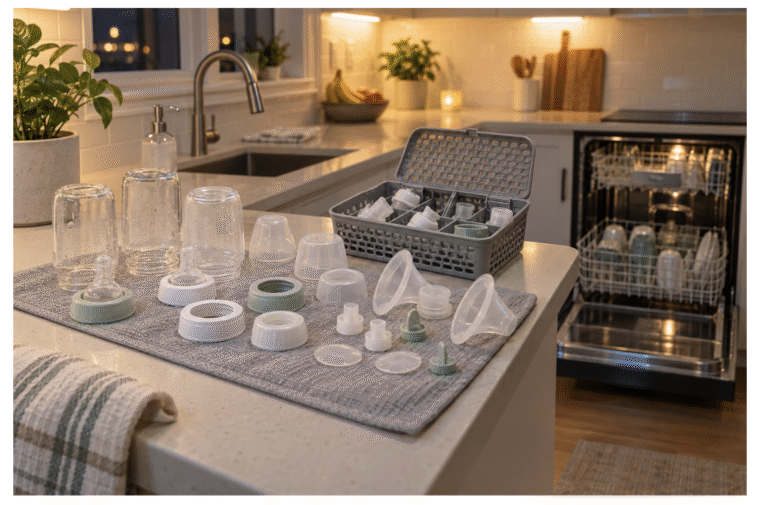
Alt: Disassembled baby bottles, nipples, collars, and pump valves drying beside a closed-top small-parts basket
Why Tiny Bottle & Pump Parts Need Special Cleaning Steps
Bottle bodies are simple to inspect and position. Nipples, collars, caps, duckbill valves, membranes and pump connectors are different. They are lightweight, oddly shaped, and packed with narrow tunnels and overlapping surfaces.
A part may look rinsed from above while milk residue hides along the rim, deep inside a valve, or between pieces that were not fully taken apart.
Disassembly matters more than which appliance you use. CDC guidance recommends caregivers fully separate bottles into individual components before cleaning, including nipples, caps, rings and valves. FDA guidance also states every milk-contact pump part must be cleaned after each use, and you must follow the manufacturer’s manual to confirm if a piece is dishwasher-safe.
Material and care instructions differ widely. Heat-resistant bottle bodies may be dishwasher-approved, while thin membranes, tubing or electronic components cannot go in the dishwasher. Treat every feeding kit separately — do not assume all parts share the same cleaning rules.
Where Dishwashers Leave Small Feeding Parts Uncleaned or Wet
Dishwashers rely on water spray, detergent, heat and cycle time. But those factors only work when water can fully reach every surface.
- A nipple pressed against another dish shields its underside.
- A flat-laid collar traps standing water.
- Lightweight valves spin mid-cycle and settle in positions that stop proper draining.
Small items also need containment. CDC recommends placing them in a closed-top basket or mesh laundry bag to stop parts from falling into the dishwasher filter.
While a basket prevents lost pieces, overcrowding creates new problems. When parts nest or stack together, the basket solves one issue — losing parts — without fixing blocked spray coverage.
Your regular family dishes also affect cleaning results. Large plates block spray paths, bowls redirect water, and tall cookware limits space around the small-parts basket. This does not mean dishwashers are bad. It means how you load the dishwasher is a critical part of cleaning, not a rushed afterthought.
Two Hidden Risks – Incomplete Drying & Mismatched Wash Timing
- Dry parts are mandatory — cleaning is not enough. Water can remain inside nipples, under collar lips, or in pump connector grooves after a wash cycle. CDC guidance recommends leaving damp items on a clean, unused towel or paper towel until fully air-dried. Avoid hand-wiping them because kitchen cloths may transfer germs. Hard-water spots are not milk residue, but they can make visual inspection more difficult.
- Match wash cycles to your baby’s feeding & pumping schedule. A dishwasher may clean well but still finish too late for the next feed or pumping session. Judge capacity by complete feeding or pumping sets, including small accessories, rather than bottle bodies alone. Track one busy day to see when dirty parts accumulate, when a cycle can start, and when dry parts are needed again. This will show whether the problem is cleaning, drying time, too few spare parts, or cycle timing.
Use This Checklist to Pick Between a Dishwasher and Baby Bottle Washer
Use this checklist to evaluate your routine — it is not a one-size-fits-all verdict.
| Decision point | A household dishwasher may work well | A dedicated baby bottle washer is likely a better fit |
| Part Compatibility | Every milk-touching component is confirmed dishwasher-safe | Your kit includes many tiny approved parts that need stable positioning |
| Loading Behavior | Closed basket holds parts without crowding, nesting or blocked spray | Parts often flip, overlap, trap water or require multiple wash batches |
| Drying Outcome | Heated dry cycle finishes with all parts dry before your next feed | Valves, collars or pump connectors consistently need extra air-drying time |
| Timing | Family dishwasher runs often enough to match feeding/pumping intervals | You need small, feed-focused batches on a predictable, fast schedule |
| Water Quality | Mineral spotting is minimal and parts are easy to inspect | Hard water marks repeatedly cloud parts and add extra maintenance |
If most of your answers fall in the middle, optimize your current dishwasher setup first:
- Use a secure closed basket
- Leave space between all parts
- Run the manufacturer-approved heated drying setting
- Keep enough complete spare bottle/pump sets so you never reuse damp parts
When a Dedicated Bottle Washer Fits the Routine
A dedicated appliance becomes relevant after you identify a repeatable workflow gap. The eufy Baby Bottle Washer S1 Pro is designed for bottles and breast pump parts. It provides a five-layer 3D HydroBlast™ spray system, a built-in water softener, dual-fan HygieniDry™ drying, and room for up to 10 bottles or 4 bottles and a full pump kit. Those features address placement, mineral spotting, drying, and batch capacity. They do not remove the need to disassemble parts, confirm compatibility, or inspect items before reuse.
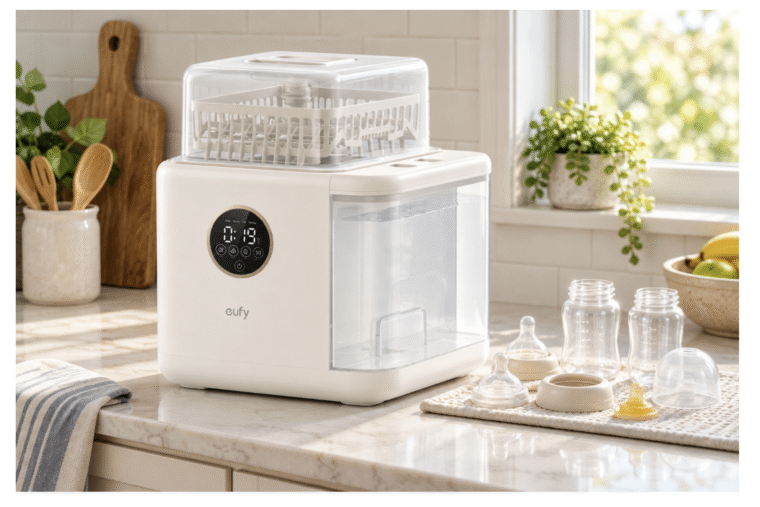
Alt: eufy Baby Bottle Washer S1 Pro on a sunlit kitchen counter beside disassembled baby bottles and small feeding parts
Before choosing any dedicated washer, list every item in your real daily load and check its care instructions. Confirm that the rack accommodates the exact bottle shapes, nipples, valves, flanges, and accessories you use. Families still comparing their broader feeding setup can review the eufy Mom and Baby collection, but the most useful comparison starts with your own number of complete sets and the time available between feeds.
Build a More Reliable Small Part Routine
Follow this repeatable workflow no matter which machine you use:
- Disassemble every milk-contact component as soon as possible after use
- Keep a dedicated bin for loose valves and membranes so they do not get lost in the sink or mixed with regular dishes
- Before loading, check grooves and openings for leftover milk residue; ensure no parts are folded, nested or covered
- Put lightweight pieces in a secure basket, leaving space for water circulation
- After the wash cycle, inspect cleanliness and dryness under bright light. Pay close attention to silicone seams, nipple openings, collar threads and deep pump connector recesses
- Move any damp pieces onto a clean air-drying surface; do not store or wipe them with kitchen towels
- Reassemble only after parts are fully dry and store in a clean protected space; keep manufacturer manuals handy
A consistent routine eliminates last-minute guesswork, whether you clean with a dishwasher or a dedicated bottle washer.
Conclusion
Choosing between a baby bottle washer and dishwasher comes down to repeatable results, not appliance labels. A dishwasher may be enough when small parts stay secure, receive full spray coverage, dry completely, and are ready on time. If pieces routinely shift, trap water, or miss your next feeding window, improve your loading and drying routine first; if those problems continue, compare a dedicated washer with your actual bottle and pump parts. The better choice is the system you can use consistently, inspect easily, and complete before the next feed.
