
Where Your Renovation Money Actually Goes in 2026
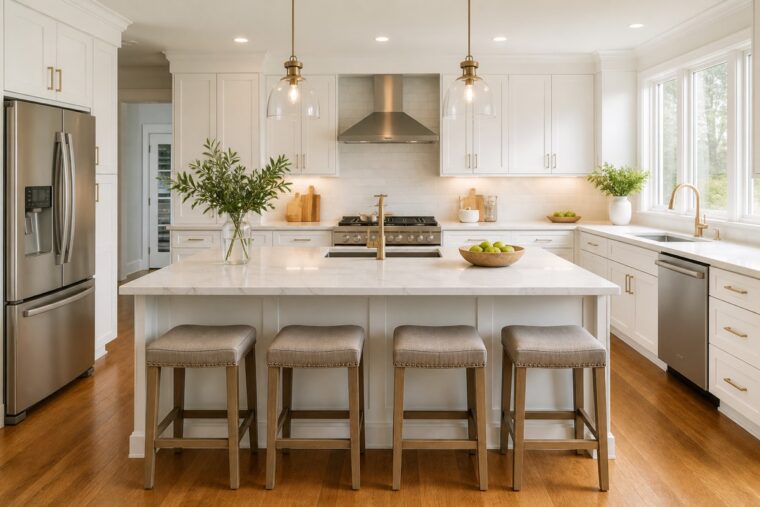
Renovation budgets rarely die from one dramatic mistake. They bleed out slowly, a few hundred dollars at a time, on upgrades that feel small in the showroom and land like a punch on the final invoice. The frustrating part is that homeowners often spend the most money in exactly the spots where guests never notice, while skimping on the cheap things that actually change how a home feels.
If you are renovating on a budget you respect, the goal is not to buy the cheapest version of everything. It is to understand where your dollars go, then spend generously where it shows and pull back hard where it does not. Once you can see the money, you can move it. Here is the map.
The three line items that eat most of your budget
Walk through any major renovation and the same three categories dominate the bill. In a kitchen, cabinets, countertops, and appliances routinely consume more than half the total. Everything else, the flooring, the paint, the hardware, the labor to install it, splits the remainder. This matters because it tells you exactly where to aim your attention. Saving 10 percent on a category that is 5 percent of your budget is rounding error. Saving 25 percent on cabinets, which might be a third of the job, is real money.
The cost tiers make the stakes obvious. A kitchen refresh that keeps the existing layout runs about $25,000 to $45,000. Step up to a standard remodel with semi-custom cabinets and quartz counters and you are at $55,000 to $90,000. Go premium with custom cabinetry and a luxury appliance package and you sail past $100,000. In a high-cost city like Los Angeles, a full kitchen commonly lands between $66,000 and $110,000. The jump from one tier to the next is driven almost entirely by those same three line items, which means that is where your savings live too.

Cabinets: the single biggest lever you control
Cabinets are usually the largest line in a kitchen and the easiest place to overspend without a visible payoff. Custom cabinetry can cost three to four times what semi-custom does, and most people who walk into your kitchen will never tell the difference. If your existing cabinet boxes are structurally sound, refacing or repainting them with new doors and hardware can save five figures and still read as brand new.
The frugal play is to spend on the parts you touch and see, like door fronts and pulls, and save on the parts hidden inside a cabinet you open twice a year. Semi-custom lines from established makers give you most of the look of custom at a fraction of the price. Reserve true custom only for the one awkward corner or unusual dimension that a stock line genuinely cannot solve.
Countertops and appliances: where patience beats budget
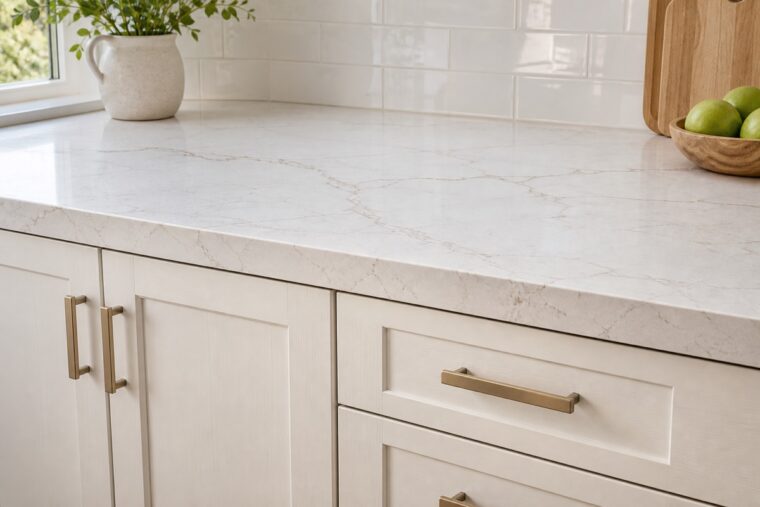
Countertops are the next big swing. Natural marble is gorgeous and high-maintenance, and it carries a premium that surprises people. Quartz gives you the durability and the stone look at a meaningfully lower price, and unlike marble it does not stain or etch when someone sets down a lemon or a glass of wine. For most kitchens, quartz is the smart-money choice, and you can save the marble for a single low-traffic accent if you must have it.
Appliances reward patience more than any other category. A mid-tier stainless package cooks dinner just as well as a luxury suite, and last season’s models go on deep discount the moment manufacturers launch new lines, usually in the fall. If you can time your purchase to those launch windows, you can outfit a kitchen with near-premium appliances for a standard-tier price. Buying your own fixtures and lighting where your contractor permits is another quiet win, because the markup on these items is often where a bid silently inflates.
The most expensive words in renovation: move it
If there is one rule that protects a budget more than any finish choice, it is this. The moment you move plumbing, relocate electrical, or knock down a wall, your costs climb fast and in ways that do not show up in the final photos. Now you are paying for demolition, structural reinforcement, new rough-ins, and the permits and inspections that come with them, all before you have spent a dollar on anything you can actually see.
Keeping your existing layout is the highest-leverage savings decision in any renovation. A bathroom that keeps its plumbing in place can be a $12,000 to $25,000 refresh. Move the toilet and the shower to opposite walls and that same room climbs toward the $30,000 to $50,000 standard tier, or beyond, for work the eye barely registers. Before you redraw a floor plan, ask whether the new layout is worth literally thousands of dollars, because that is what it costs.
Match your spending to how long you will stay
The smartest frugal question is not what something costs, it is whether the cost fits your timeline in the home. If you plan to sell within a couple of years, pour your money into the projects buyers reward and skip the ones they do not. A clean, updated kitchen and bathroom move a sale price; a six-figure custom kitchen in a mid-priced neighborhood almost never returns what it cost. Spending above your block is one of the quietest ways homeowners lose money on renovation.
If you are staying for the long haul, the math flips. Now it is fair to spend on the things that make daily life better even if they do not show up dollar for dollar at resale, like a layout that finally works or finishes you will enjoy for fifteen years. Either way, decide your timeline first, because it tells you which upgrades are investments and which are pure indulgence. A frugal renovator is not cheap. She just refuses to spend on the wrong things for her situation.
Watch out for the budget killers that deliver no payback at all. Over-customizing for your own narrow taste, chasing trends that will date in five years, and gold-plating utility spaces like laundry rooms and garages are classic ways to sink money you will never see again. Keep those spaces clean and functional, and move the budget to where it actually earns its keep.
How to tell if a quote is fair before you sign
Here is the skill that protects your wallet more than any single material choice: knowing whether a contractor’s number is reasonable before you commit. A quote means nothing in isolation. It only means something next to the real cost range for your project and your city.
If a bid for a standard kitchen comes in at $130,000 in a market where the going rate is $55,000 to $90,000, one of two things is true. You are getting premium scope you did not ask for, or you are being overcharged, and you need to know which. Before I react to any quote, I pull Renology’s 2026 renovation cost data and check the range for my project and my area, so I can tell at a glance whether a number is grounded or padded. The same check works for every room. A bathroom can run anywhere from $12,000 for a modest refresh to $80,000 for a luxury rebuild, so a $40,000 quote is neither high nor low until you know the scope behind it.
When you do get bids, demand they be itemized. A fair quote names specific materials and brands, breaks out labor from materials, and states its assumptions. A single lump-sum number with no detail is a quote you cannot evaluate, and that lack of detail is usually a choice, not an oversight. Itemized pricing also shows you exactly where to trim, because you can see which finish to swap or which upgrade to skip without anyone ever noticing.
Spend where it shows: the cheap upgrades worth every dollar
After all this talk of saving, here is the flip side. A few of the lowest-cost upgrades deliver the biggest visible payoff, and those are the ones to fund without flinching. Fresh paint and new flooring change how an entire home reads for a relatively small outlay, and they touch every room at once. Good lighting transforms a space for the price of a few fixtures. New hardware and faucets are cheap jewelry that make older cabinets and tubs feel current.
Frugal does not mean bare. It means deliberate. Put your money into the surfaces you touch and the rooms you live in every day, hold a firm line on the luxury upgrades that mostly serve a brochure, and never, ever sign a quote you have not measured against a real number. Do that consistently and you can renovate beautifully on a budget that respects both your home and your bank account.
