
Understanding why a galvanized metal shed protects a two-car space better than stick-built construction
The American storage gap a steel structure quietly fills
Across much of the United States, homeowners and rural property owners reach a familiar wall: they own two vehicles, a tractor, or several seasons of equipment, yet pouring a foundation and framing a stick-built garage costs more time and money than the need justifies. A metal shed sized for a double garage answer that gap, delivering covered, lockable square footage without the permits, lumber, and skilled trades that conventional construction demands.
This article looks past the product label and into the physics. The goal is to explain, in plain terms, why a particular kind of steel building resists weather and holds a clear floor where other approaches sag, rust, or crowd the space with posts.
Once the underlying mechanisms are clear, the trade-offs between one design and another stop feeling arbitrary. They become predictable consequences of geometry and chemistry, and a buyer can read a specification sheet and know what it implies for the next twenty years.
It helps to think of a metal shed not as a single product but as a set of engineering choices stacked together. The coating decides how it ages, the panel shape decides how it stands, and the roof decides how the inside feels to use.
Why zinc dies so the steel does not
Bare steel rusts because iron willingly gives up electrons to oxygen and water, and the resulting iron oxide flakes away, exposing fresh metal to repeat the cycle. Paint slows this only as long as the film stays unbroken; one deep scratch and corrosion creeps underneath, lifting the coating as it spreads.
Galvanizing works on a smarter principle. A bonded layer of zinc sits higher on the scale of chemical reactivity than iron, so when moisture arrives the zinc corrodes first and the steel is left untouched. This is sacrificial protection, and it is the reason a fully galvanized metal shed shrugs off the small dings and scratches that doom a painted one.
The intuition is a bodyguard who steps in front of the principal. Even where the surface is nicked and the steel is briefly exposed, surrounding zinc keeps dissolving in its place, so the wound never becomes a rust hole. The protection is electrical, not merely a physical barrier.
This distinction is easy to miss when comparing two buildings in a showroom, where both look clean and new. The difference only shows itself after the first few winters, when a painted structure begins to streak with rust at every edge and the galvanized one does not.
How a ridged surface beats a flat one
A flat sheet of thin steel flexes alarmingly under a hand, yet the same metal folded into repeating ridges turns rigid. Corrugation does not add material; it changes shape so that bending the panel would require stretching and compressing the folds, which the geometry strongly resists.
The everyday parallel is corrugated cardboard, whose fluted middle layer lets a light box carry real weight. The wall panels of a metal shed borrow the same trick, staying light enough to lift by hand while standing up to wind pressure and the occasional knock from a vehicle.
This is why a metal shed can be both economical and strong. The stiffness comes from folding, not from thickness, so the structure spends its mass efficiently rather than relying on heavy plate.
The folds also run vertically on the walls, which helps in another way. Rainwater follows the channels straight down and off the building rather than pooling, so the surface dries quickly and gives corrosion fewer chances to start.
Classifying sheds by the shape of the roof
Roof geometry is the clearest way to sort these buildings, because it dictates how water leaves, how much headroom you get, and whether the interior stays open.
- Apex or gabled: two slopes meet at a central ridge, shedding water and snow to both sides
- Single-slope pent: one flat plane tilts to one edge, simple but lower overall
- Lean-to: a single slope built against an existing wall, useful as an add-on
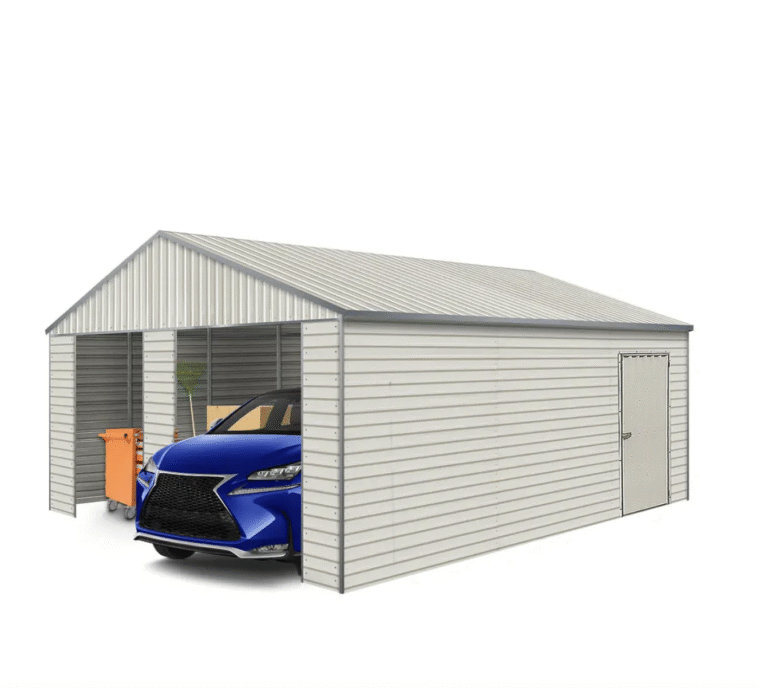
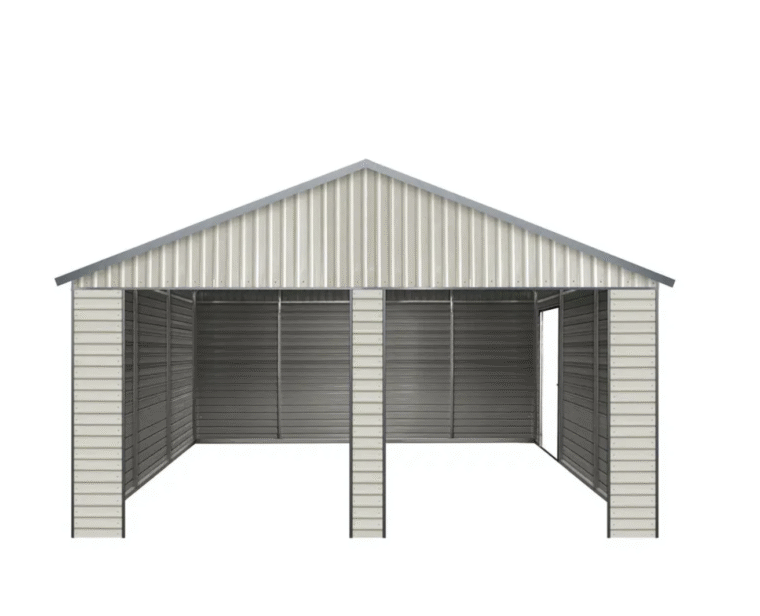
The apex roof is the natural choice for a double garage. Because the opposed panels brace against each other where they meet at the ridge, the roof carries its own load to the outer walls and needs no internal posts. That structural honesty leaves a genuinely clear two-car floor instead of one interrupted by columns.
The ridge also raises the ceiling along the center line, adding usable headroom for tall vehicles, overhead storage, or simply standing upright with the doors closed. A pent or lean-to design trades that height and self-supporting span for a simpler, lower silhouette.
Coatings, and the honest cost of each
Sheds also divide by how their steel is finished. A painted skin can offer a wider palette and a softer look, but its corrosion resistance depends entirely on keeping the film intact, and field damage is hard to avoid over years of use.
A galvanized finish prioritizes longevity over appearance. It resists rust at scratches and cut edges, which matters most in humid, coastal, or hard-working rural settings where a building takes real abuse. The trade-off is a utilitarian silver-gray surface rather than a designer color.
For a structure meant to shelter vehicles for decades with minimal upkeep, the durable coating usually wins the reasoning. The appearance compromise is small next to the maintenance a painted equivalent would eventually demand.
Two doors doing two different jobs
A double garage building carries wide vehicle doors for driving in and out, but opening a large door every time you need a single tool wastes effort and lets in weather. A separate, person-sized side door solves this directly.
The side door provides pedestrian access without disturbing the main openings, so the interior stays sheltered and a parked vehicle is not in the way. It is a small design decision that meaningfully changes how the space is used day to day.
There is a security dimension as well. The large doors can stay shut and locked while routine comings and goings pass through the smaller, more easily secured side entrance, reducing wear on the main mechanisms over the life of the metal shed.
A working example on a Texas property
Consider a rural family in central Texas storing two trucks, a riding mower, and feed. A twenty-one by nineteen-foot galvanized building with an apex roof and a side door let them park both vehicles under one clear span, reach equipment through the smaller door, and rely on the zinc coating through humid summers without repainting.
Understood as a system of zinc chemistry, folded geometry, and load-bearing roof shape rather than a catalog item, a metal shed becomes a rational answer to a common American need: large, durable, low-maintenance covered space delivered without the expense and delay of conventional construction.
