
The Three Bid Questions That Separate Honest AC Installers From Upsells
The honest bid is rarely the cheapest, and almost never the biggest. A family replacing a worn three-ton system on a fixed budget lays three quotes side by side and finds numbers that swing by thousands for the same job. The spread is the warning, and telling an honest quote from a padded one comes down to what a good air conditioning contractor olympia wa crew shows you first. Vetting an installer on load math, honest pricing, and correct sizing protects that budget, and three plain questions do most of the work.
Wild Bid Spreads Hide the Real Cost
Lay three bids on the kitchen table and the range jumps out first. Say they land at $7,400, $9,100, and $12,600 for the same house, a gap that reads like cheap versus premium. It rarely reflects better equipment, though, and more often reflects a different guess about what the home actually needs. A load calculation exists to replace that guess with room-by-room math. The lowest bid may have quietly dropped the permit, while the highest simply rounded the tonnage up to pad the ticket. The cheapest bid and the biggest bid can both be wrong for the same house.
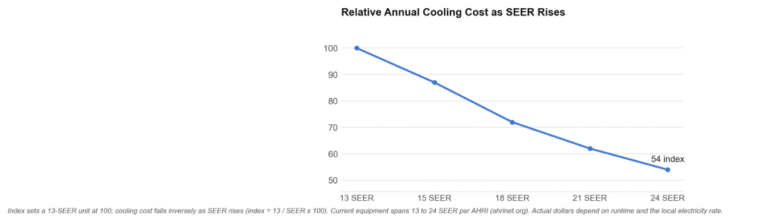
Efficiency is where that gap compounds over the years. A higher SEER rating trims the cooling cost every summer the system runs, so a right-sized, well-rated unit beats both the cut-rate box and the oversized one over time. The chart above indexes that relationship against a basic 13-SEER baseline, and the curve keeps bending down as the number climbs. The lesson is not to chase the highest rating on the shelf, because a system two sizes too big will cycle itself ragged no matter the sticker.
The Load Calculation Honest Installers Show You
The first question makes an upsell squirm. Ask each bidder to show the Manual J load calculation, the room-by-room math that sizes the system to your square footage, insulation, and windows. An honest installer has it ready or will run it, and the case we see most often is that padded bids skip it entirely. Rule of thumb almost always rounds up, because a bigger unit is a bigger ticket for the shop and nobody complains about a house that cools fast.
Right-sizing matters more now that the incentives have changed. The Internal Revenue Service confirmed the federal heat pump tax credit, worth up to $2,000 a year, expired after December 31, 2025. Buyers who leaned on that December 2025 deadline to soften a big install now pay full freight. That turns an oversized system into a straight loss instead of a partly subsidized one. A careful air conditioning contractor olympia wa crew walks you through the load numbers and points you to ENERGY STAR’s free Home Advisor tool so you can sanity-check the sizing yourself.
Financing a System You Actually Need
The second question is about money on paper. Ask for an itemized quote and financing terms in writing, not one bundled number with a tidy monthly payment attached. Transparent pricing means each line stands on its own, the equipment, the labor, the permit, so you see exactly what a higher bid actually buys. Financing a system you actually need beats financing the one a salesperson talked you into, because that payment follows you for years after the heat fades.
Padding hides inside bundles. Break the bundle into line items and it is easy to spot.
Remember that the whole point of this is comfort, not paperwork. A neighbor spent an entire July fighting the thermostat while an oversized system short-cycled in the garage closet, never really pulling the humidity out of the house. Anyway, back to the financing. A right-sized system costs less to buy and less to run, so the loan is smaller on both ends and you never pay interest on capacity you will not use.
One Question Reveals the Upsell
The third question is a quiet trap for the upsell. Ask the installer to justify the tonnage against your square footage and this region’s mild climate, then watch the answer land. An honest crew ties the size straight to the load calculation and the local weather, while an upsell reaches for vague talk about headroom for hot days. This corner of the state gets few brutal cooling days, which is exactly why oversizing here is so common and so costly.
Local weather is a fair thing to raise, and the record backs the honest answer. CBS News reported that NOAA’s 2025-2026 winter outlook favored above-normal precipitation across the Pacific Northwest from December through February. Homes here spend more of the year damp and mild than baking, so sizing for a rare heat spike sells a machine that short-cycles most of the season. The right question does more than expose the upsell, it puts the honest installer on record about the smaller, correctly rated system.
Three bids will always come back with three different numbers, and the spread is not the problem to solve. The real question is whether each installer can show its work, the load calculation, the itemized price, and a straight answer on sizing. Ask those three questions and the padded quote usually folds on the first one. The bid that survives all three is the one worth signing, wherever it happens to sit in the range.
