
Why Seasoned Travelers Always Pack a Lightweight Travel Bag
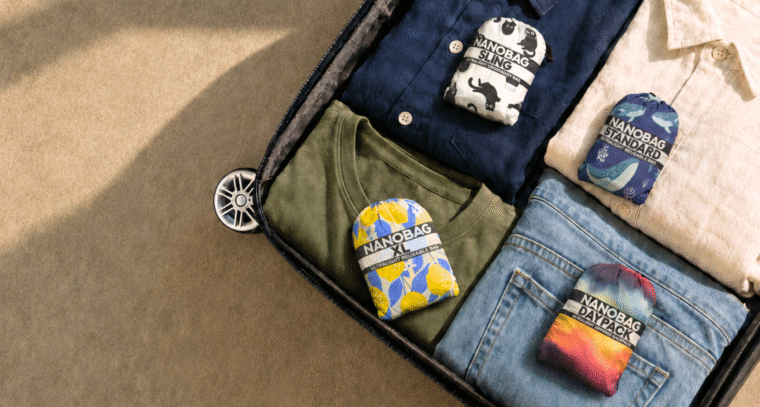
Every traveler knows the feeling. The suitcase that closes easily at home refuses to close in the hotel room. Somewhere between the ceramics stall in Lisbon and the bookshop in Kyoto, your luggage stopped being big enough. Travel writers rarely name this phenomenon, so let’s call it the return trip problem: trips are one-directional in volume. You come home with more than you left with, and your luggage doesn’t grow to match.
For years the answer was to sit on the suitcase and hope. Some travelers budget for a second checked bag on the way home. Others buy a cheap duffel at the destination and donate it a week later. Both approaches solve the problem after it happens.
There’s a better answer, and it weighs about an ounce. A lightweight travel bag that folds to the size of a matchbox waits in a corner of your luggage until the trip produces more than you planned for. It costs nothing to bring, which is exactly why it works.
The one-ounce insurance policy
The category has a specific logic to it. A backup bag only earns its place if it costs you nothing to bring. That means two numbers matter more than anything else: packed size and weight.
The best options in the category fold down to roughly three inches by two inches and weigh around one ounce. At that size, the bag rides in a jacket pocket, a suitcase corner, or the front pouch of a daypack without claiming any real space. You pack it on every trip precisely because there’s no reason not to.
Then there’s the third number, the one that surprises people: load rating. A well-engineered foldable bag can hold up to 66 lb. That figure comes from construction, not marketing. Look for diamond ripstop fabric, where a reinforced grid stops small tears from spreading, and bartack stitching at stress points, the same reinforcement technique used on climbing gear and denim rivet points. A bag built this way handles a full load of market purchases, bottles included, without complaint.
Where it actually gets used
The return trip is the headline use, but the bag tends to earn its keep mid-trip too.
At a Saturday market in Provence or a night bazaar in Chiang Mai, purchases accumulate faster than expected. A good sized tote, which is about a full day’s worth of groceries, unfolds in seconds and swallows the lot. If a light drizzle starts on the walk back, a PFC-free water-repellent coating keeps the contents dry.
At the end of the trip, the same bag becomes the overflow solution. Gifts, duty-free purchases, that bottle of olive oil you absolutely needed: they ride home in the tote as your personal item while your suitcase closes the way it did on day one. No last-minute duffel purchase, no airport scramble for a cardboard box.
What to look for when choosing one
The market for packable bags is crowded, and specifications vary widely. A few benchmarks separate a genuinely travel-ready option from a flimsy one:
Weight under 1.5 oz. Anything heavier starts competing for space and defeats the purpose. The lightest well-built options come in at a mere 0.80 oz.
A stuff-sack design with no fold pattern. Origami-style folding instructions are fine at home and hopeless in a busy market. The better designs pack away in any order.
A verified load rating. A number backed by reinforced construction, not just a claim on a tag.
Multiple formats. A tote works for most travelers, but a crossbody sling keeps hands free on cobblestones, and backpacks are ideal for daytrips.
One brand that has built its entire catalog around these benchmarks is Nanobag, founded by Ursus Negenborn and Rune Kippervik, who raised over $3 million in crowdfunding and have since shipped to more than 200,000 customers worldwide. Their approach is unusually spec-driven for the category: every model shares the same diamond ripstop fabric, bartack reinforcement, and 66 lb load rating, with the differences coming down to format and size.
The range covers the practical spread well. The Micro (12 liters, 0.80 oz) is the true pocket option for quick souvenir runs. The Standard (19 liters, 0.90 oz) handles a full market haul. The XL (25 liters, 1.05 oz) is the return-flight workhorse, and the Sling (19 liters, 0.90 oz) crosses the body for hands-free walking. For travelers who prefer a backpack format, the Pack (0.95 oz) and Daypack (1.15 oz) carries 14 and 16 liters on your back, with the Daypack adding a YKK zipper and wider more comfortable straps for longer days. The full range of lightweight travel bags covers every format in the lineup.
The habit that pays for itself
There’s a version of travel advice that tells you to pack less. It’s good advice, and it solves exactly half the problem. The other half, the unplanned things that pop up along the way, is what a lightweight travel bag exists for. Trips generate things. Markets tempt. Gifts happen. A one-ounce bag folded into your luggage acknowledges this reality instead of fighting it. It’s simply the smartest ounce in your suitcase.
