
Which Pot Is Best for Cooking Rice on the Stove
Rice is one of the cheapest things you can put on a table, and it is also one of the easiest to ruin. Scorched bottoms, boil-overs that coat the burner, a gummy middle layer that never quite dried out: nearly all of it comes down to the pot, not the cook.
The fix is usually not an expensive pot. It is a specific shape and a specific weight, and once you know what to look for, you can judge a candidate in about ten seconds by picking it up.
Heavy bottoms solve the burnt-rice problem
Thin pots have hot spots. The flame hits one patch of metal, that patch gets much hotter than the rest, and the starch sitting on it caramelizes and then burns while the rice an inch away is still chalky.
A thick base spreads that heat sideways before it reaches the food. You will see heavy-gauge bottoms measured in millimeters on cookware built for rice, around 4mm on the sturdier aluminum pots, and tri-ply bases on stainless models that sandwich a conductive layer between steel.
Pick up any pot you are considering. If it feels like a tin can, it will burn rice.
Width matters more than people expect
Rice cooks best in a shallow bed, not a deep column. A wide, flat bottom gives the grains room to steam evenly, which is why pots built for large batches often run 14 inches or more across the base. Tall narrow pots do the opposite: the rice at the bottom compacts under the weight of everything above it and ends up wet and dense while the top layer stays dry.
That same width also helps with the boil-over that happens when starchy water climbs the sides. More surface area means the foam has somewhere to go.
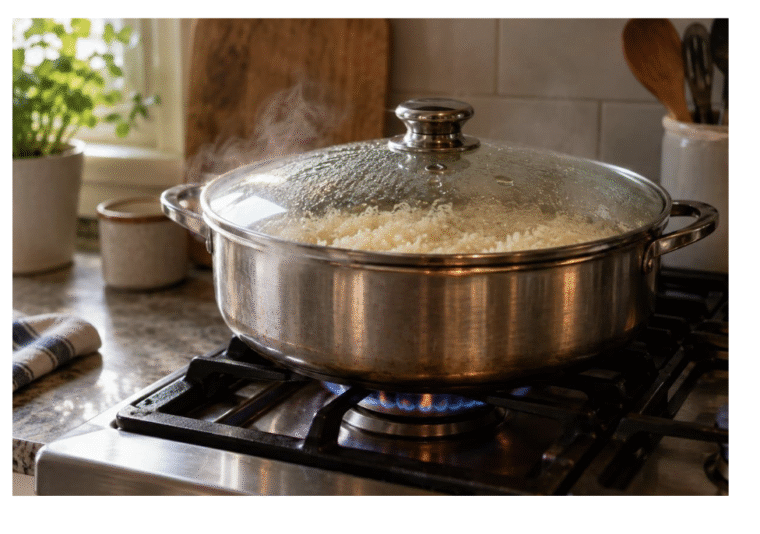
The lid does half the work
Once the water is absorbed, rice finishes by steaming in its own trapped moisture. A loose or warped lid lets that steam leave, and you end up adding more water, cooking longer, and getting a softer result than you wanted.
A tight lid, flat or domed, is the baseline. But there is a version of this that goes further, and it comes from the biryani tradition: a dum lid with a rim that holds water on top. The water keeps the lid cool, steam condenses underneath, and the droplets fall back into the rice instead of escaping into the kitchen.
What a biryani handi does that a regular saucepan doesn’t
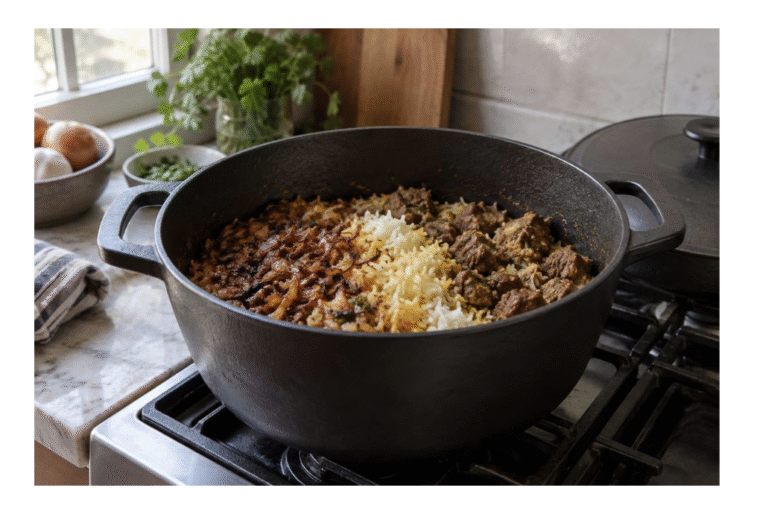
If you cook rice dishes that involve layering, meat, par-cooked rice, fried onions, sealed and left alone over low heat, the pot stops being incidental. The sealed-steam effect of a water-holding lid lets you cook with noticeably less added liquid, which concentrates flavor rather than diluting it.
The main fork in the road is material. Hard-anodized aluminum is lighter and heats fast, which matters when you are lifting a pot that already weighs eight to twelve pounds loaded. Stainless steel with a tri-ply base is heavier and slower to come up to temperature but will outlast you, and it is the one that works on induction. If you want to see how that trade-off plays out in actual handis, the best pot for biryani roundup breaks down which ones ship with a true dum lid versus a flat one that just happens to fit.
Size splits the same way. A 5-liter handi feeds roughly six to ten people and still fits in a normal cabinet; a 12-liter handles twenty to twenty-five servings and needs real shelf space and real arm strength.
For a frugal kitchen, the 12-liter earns its keep if you host. Biryani is a stretch-the-budget dish by design, a little meat and a lot of rice, and cooking a single large batch costs less per serving than running two batches back to back.
The pot’s material decides how the rice turns out
Hard-anodized aluminum resists corrosion and cleans up with hand washing, no seasoning required. If it has a nonstick interior, that coating will eventually wear, especially under metal ladles and hard scrubbing, and there is no way to restore it once it goes. Polished hard-anodized without the nonstick layer takes metal utensils fine.
Stainless will not scratch out, but it takes more scrubbing and the occasional polish to keep watermarks off.
Clay is the outlier. Unglazed clay cooks rice gently and gives a flavor that metal does not, though it is fussier about heat changes and suits aged parboiled or basmati rice better than the starchier short-grain varieties.
Handles are a safety feature, not a styling choice
A full rice pot is heavy before it ever gets hot. Riveted stainless handles or cool-touch fiberglass ones that are bolted through, not spot-welded, are what you want.
Wooden and rosewood handles stay cool and look good, but they need to be kept out of standing water and away from the flame. Before you commit to any pot, grab both handles and imagine moving it wet and full across a counter.
Check your cooktop before anything else
This is the detail that sends pots back. Most hard-anodized aluminum handis are not magnetic, so they will do nothing on an induction burner no matter how well made they are. Gas, electric, ceramic, and halogen are generally fine.
If you cook on induction, look for stainless or a tri-ply base with a magnetic layer, and confirm it in the specifications rather than assuming. And whichever pot you land on, keep it out of the dishwasher: the detergent dulls anodized surfaces fast, and ten minutes of hand washing buys you years.
